


Common Issue:
Loose electrical connections are one of the most common—and most overlooked—causes of electrical problems in residential construction. They don’t usually fail immediately. Instead, they create heat over time, slowly damaging conductors, terminals, and equipment until a breaker trips, insulation fails, or in the worst cases, a fire starts.
After decades in the electrical trade, one thing becomes very clear: loose terminations happen more often than most people realize, even on otherwise well-built projects.
Why Loose Connections Are So Easy to Miss
On a typical residential project, there can be hundreds of individual wire terminations:
- Breakers
- Neutral bars
- Ground bars
- Disconnects
- Equipment lugs
- Splices
- Devices
Even with good workmanship and inspections, it only takes one missed or improperly terminated conductor to create a problem later. Electrical systems often pass inspection and function normally for months or years before issues surface.
This is not about carelessness—it’s about volume, repetition, and human factors.
What Happens When a Connection Is Loose
A loose electrical connection does more than simply “create resistance.” It typically triggers a chain reaction that worsens over time:
Progressive failure over time
Loose connections rarely fail immediately. Heat, thermal movement, and arcing compound the issue gradually until signs such as discoloration, burning odors, nuisance tripping, or equipment failure finally appear—often after significant internal damage has already occurred.nclosures where they aren’t visible until damage is already done.
Reduced contact surface area
A properly torqued termination creates solid metal-to-metal contact. When a connection is loose, current is forced through a smaller contact area, increasing current density at the termination point.
Localized heating at the connection
The increased current density generates heat concentrated at the lug, breaker, or terminal—not along the wire—making the problem difficult to see until damage occurs.
Thermal expansion and contraction
As electrical loads turn on and off, the connection repeatedly heats and cools. This movement can further loosen the termination over time rather than stabilize it.
Arcing and micro-arcing
As contact quality degrades, small gaps can form. Electricity may begin jumping these gaps, creating arcing or micro-arcing that produces extremely high localized temperatures capable of damaging metal and insulation.
Why Solar and DC Systems Increase the Risk
Loose connections become even more critical when solar, battery storage, or other DC systems are involved.
Unlike AC, DC current does not naturally pass through zero, which means:
- Arcs are harder to extinguish
- Heat buildup can be more severe
- Failures can escalate faster
With higher continuous loads and longer duty cycles, small termination issues in DC systems can have disproportionately large consequences.
The Torque Issue No One Talks About
Most electrical panels, breakers, lugs, and terminals come with manufacturer-specified torque values. These values are not suggestions—they are engineered limits designed to ensure proper contact without damaging the conductor or terminal.
In practice, however:
- Torque wrenches are rarely used in residential work
- Connections are often tightened “by feel”
- Inspectors do not typically verify torque
- Home inspectors do not test terminations
Instead, many connections are over-torqued under the assumption that tighter is safer.
Why Over-Torquing Is a Problem
Over-torquing can be just as dangerous as under-torquing.
Potential issues include:
- Damaged conductor strands
- Deformed lugs or breaker terminals
- Reduced contact surface area
- Cold flow over time, causing the connection to loosen later
A connection that feels solid on day one can actually become unstable months or years later due to material deformation.
Why This Is an Industry-Wide Blind Spot
Electrical inspections are designed to verify:
- Code compliance
- Correct installation methods
- Proper equipment usage
They are not designed to re-torque hundreds of connections. As a result, torque compliance is often assumed rather than verified.
This does not mean inspections are ineffective—it means some risks fall outside what can realistically be checked once drywall is up and power is on.
What Homeowners and Builders Should Take Away
Loose connections are not always the result of bad work—but they are a real risk that deserves attention, especially as homes add:
- Solar
- EV chargers
- Battery systems
- Larger electrical services
- Continuous high-load equipment
Quality electrical work is not just about passing inspection. It’s about long-term reliability, heat management, and following manufacturer requirements that exist for a reason.
The Bottom Line
Electrical systems are only as reliable as their terminations.
Loose or improperly torqued connections may go unnoticed for years, but when they fail, the consequences can be serious. Paying attention to termination quality, torque specifications, and system design is one of the most effective ways to reduce long-term electrical risk in a home.
A Challenge to the Industry: Following Manufacturer Instructions
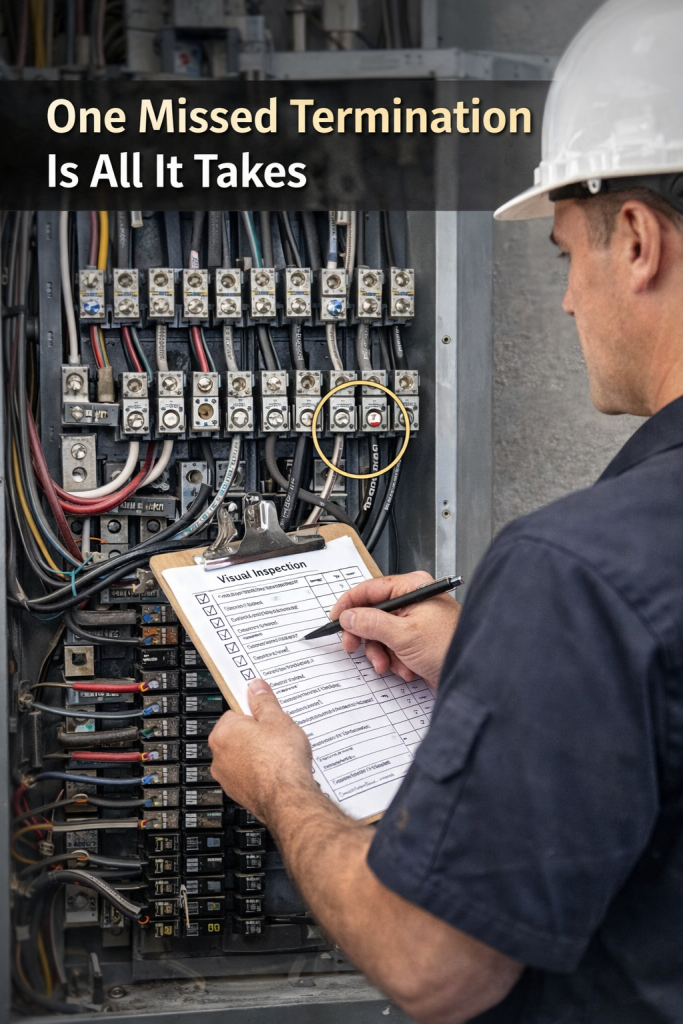
The National Electrical Code already provides clear guidance on this issue.
NEC 110.3(B) requires that electrical equipment be installed and used in accordance with the manufacturer’s instructions. For panels, breakers, lugs, and terminals, those instructions almost always include specified torque values.
In practice, however, torque verification is often assumed rather than confirmed.
This presents an opportunity—not for blame, but for improvement.
- Electricians can reinforce best practices by using calibrated torque tools on terminations where manufacturer specifications exist, particularly on services, feeders, solar, battery, and EV-related equipment.
- Electrical inspectors can reasonably spot-check terminations during rough-in or “power-to-panel” inspections, before systems are fully energized. Verifying a small sample can quickly indicate whether proper torque practices are being followed.
- Home inspectors, when appropriate and safe, can request that power be turned off to allow limited inspection of accessible terminations, or recommend further evaluation by a qualified electrician when concerns are identified.
Torque verification does not require checking every terminal. Spot checks, combined with professional judgment, can effectively confirm whether manufacturer instructions—and by extension, code requirements—are being respected.
Following torque specifications is not about overbuilding or adding unnecessary steps. It is about complying with existing requirements and reducing long-term risk in electrical systems that are becoming more powerful and more complex every year.